Mocha Mousse Patterns: A Comprehensive Guide to Seamless Twisted Designs
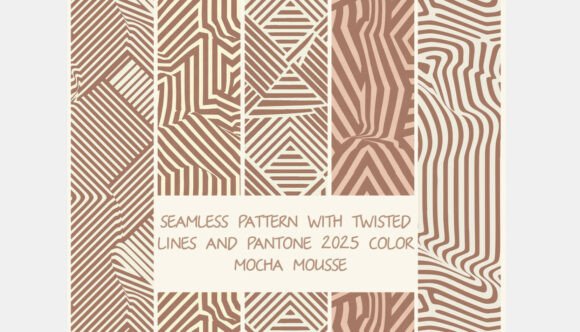
In the ever-evolving landscape of digital design and textile art, finding a pattern that balances organic warmth with geometric precision can be a challenge. Enter Mocha Mousse Patterns, a sophisticated collection that has captured the attention of creators, fashion designers, and interior decorators alike. This specific aesthetic is defined by its unique combination of twisted lines, linear tiling, and optical maze elements, all rendered in the rich, earthy tones associated with mocha and mousse.
Whether you are looking for high-resolution assets for print media or seamless textures for web design, understanding the nuances of this style is crucial. This guide explores the characteristics, applications, and practical benefits of using Mocha Mousse Patterns in your creative workflow, focusing on the technical specifications and artistic value they bring to a project.
The Anatomy of Mocha Mousse Patterns
To truly appreciate the utility of these designs, one must first understand their structural composition. The term "Mocha Mousse" refers not just to the color palette—typically consisting of deep browns, creamy beiges, and soft tans—but also to the texture implied by the visual weight of the patterns. These designs are rarely static; they are engineered to create movement and depth.
Twisted Lines and Linear Tiling
The hallmark of this collection is the use of twisted lines. Unlike simple straight stripes, these lines curve, loop, and intersect in ways that mimic natural fibers or flowing liquids. When combined with linear tiling background techniques, the result is a seamless repeat that feels infinite rather than repetitive. This is particularly important for large-scale applications like wallpaper or fabric bolts, where visible seams can ruin the illusion of continuity.
- Organic Flow: The twists prevent the eye from getting stuck, encouraging a more dynamic viewing experience.
- Seamless Integration: Properly tiled, these patterns allow for easy scaling in software like Photoshop or Illustrator without awkward gaps.
Stripy Weaving and Optical Mazes
Beyond simple twisting, many variations within the Mocha Mousse Patterns Collection incorporate stripy weaving effects. This technique simulates the look of interlaced threads, adding a tactile quality to flat digital images. Furthermore, some designs utilize an optical maze approach, where overlapping lines create secondary shapes and negative space that shift depending on how the viewer focuses. This adds a layer of intellectual engagement, making the pattern feel alive and responsive.
Technical Specifications and Quality Standards
For professionals working in high-end printing or digital display, resolution and format are non-negotiable. The standard offering for these patterns is typically provided as a 6000×6000 JPEG. This massive resolution ensures that even when scaled up to billboard size or printed on large-format textiles, the image remains crisp and free of pixelation.
- Resolution Clarity: At 6000 pixels per side, the detail in the twisted lines and weaving effects is preserved at a microscopic level.
- Format Versatility: While JPEG is common for its compression efficiency, the high bit-depth often available in these files allows for significant editing without loss of quality.
- Color Accuracy: The mocha and mousse tones are calibrated to remain consistent across different screen types and print mediums, ensuring brand consistency.
Practical Applications Across Industries
The versatility of Mocha Mousse Patterns means they are not confined to a single niche. Their neutral yet rich color palette makes them suitable for a wide array of industries, from luxury retail to modern tech interfaces.
Fashion and Textile Design
In the fashion world, these patterns are ideal for creating backgrounds for lookbooks, tags, and packaging. The twisted stripes evoke a sense of handcrafted quality, which resonates well with consumers seeking authenticity. Designers often use these seamless tiles to generate endless yardage for dresses, scarves, and upholstery fabrics. The optical maze effect can be particularly striking in evening wear, catching light and shadow in complex ways.
Interior Decoration and Architecture
Homeowners and interior designers frequently turn to Mocha Mousse Patterns for accent walls, rug designs, and curtain prints. The warm brown tones provide a grounding element in a room, while the linear tiling adds height and structure. Because the pattern is seamless, it can be applied to curved surfaces or large architectural features without visible breaks, creating a cohesive environment.
Digital Media and UI/UX Design
Web developers and app designers use these high-resolution assets for hero banners, loading screens, and background textures. The optical maze elements can be used subtly to draw attention to call-to-action buttons without overwhelming the user interface. The neutral colors ensure that text remains readable and that the pattern does not compete with primary content.
Evaluating Suitability for Your Project
Before integrating Mocha Mousse Patterns into a project, it is essential to consider the context. While powerful, no single design fits every scenario. Here are key factors to evaluate:
Visual Weight and Contrast
Due to the density of the twisted lines and weaving effects, these patterns have a moderate to high visual weight. They work best when paired with ample white space or solid-color accents. If your project involves heavy text overlay, ensure there is sufficient contrast between the text and the pattern to maintain readability.
Brand Alignment
Consider whether the warm, earthy tones align with your brand identity. Mocha Mousse Patterns convey comfort, stability, and sophistication. They may not be the best fit for brands aiming for a neon, cyberpunk, or ultra-minimalist aesthetic. However, for businesses in coffee, hospitality, artisanal goods, or sustainable fashion, they are nearly perfect.
Printing vs. Digital Use
While the 6000×6000 JPEG is excellent for both, keep in mind that digital compression might slightly alter the subtle gradients in the mousse tones. For critical print jobs, always request a PDF or TIFF version if available, or proof print a small section to check color fidelity. The stripy weaving details, in particular, can suffer if the print resolution is too low, so verify the DPI requirements of your printer.
Strengths and Considerations
Understanding the limitations of any design asset is just as important as knowing its strengths. Below is a balanced view of what to expect when working with this collection.
- Strength - Timelessness: The abstract nature of the twisted lines avoids trendy motifs that may date quickly, ensuring longevity in your designs.
- Strength - Scalability: The seamless nature allows for infinite expansion, reducing file size concerns when tiling in design software.
- Consideration - Complexity: In very small sizes (such as favicons or mobile icons), the intricate details of the optical maze may become muddy. It is best suited for medium to large displays.
- Consideration - Color Matching: While the mocha tones are generally neutral, they can appear warmer or cooler depending on the ambient lighting of the physical space or the color temperature of the digital screen.
Conclusion
Mocha Mousse Patterns represent a intersection of artistic expression and technical precision. By combining twisted lines, linear tiling, and optical maze elements in a high-resolution 6000×6000 format, they offer unparalleled flexibility for creators across multiple disciplines. Whether you are designing a luxurious textile collection, a modern website background, or elegant packaging, these patterns provide a reliable and aesthetically pleasing foundation.
As you explore this collection, remember to test the patterns in context. Look at how the stripy weaving interacts with your typography and how the twisted stripes guide the viewer’s eye. By paying attention to these details, you can harness the full potential of Mocha Mousse Patterns to create work that is not only visually stunning but also functionally effective.
For those seeking to elevate their projects with a touch of organic sophistication, investing time in understanding and applying these seamless patterns is a decision that pays dividends in both quality and user engagement.